Grip Gains celebrates its first birthday on September 4th, 2025. I'm not one for following convention, so let's celebrate today instead. 10 months in and we have 77,705 grip sessions from 510 users. I called my pocket in the Grip Gains launch video:
"If you haven't achieved elite status within your first decade, in the vast majority of cases, you never will. I did the impossible. I transitioned from a middle of the pack intermediate climber to having one of the most accomplished tick lists in Nova Scotia history, setting the standard for hard climbing locally."
— Coach Grip Gains
I knew then GG was the most effective grip training program on the planet. The question remained: does it work for other people? We now have the answer.
Not everyone is gonna make it... but most of you will
We always knew not everybody was going to find success with Grip Gains. It's hard. People don't like hard things. However, the user retention stats wildly exceed my personal expectations.
Given what I see at the climbing gym these days, strapping a torture device to your fingers and inflicting spiritual levels of pain could never have this kind of success in the wider climbing population. Grip Gains has found its people — and this speaks volumes about the wisdom of our zero-marketing approach. Organic adoption via real-world success stories. So keep it up — if you like Grip Gains, tell your friends. But only the motivated ones.
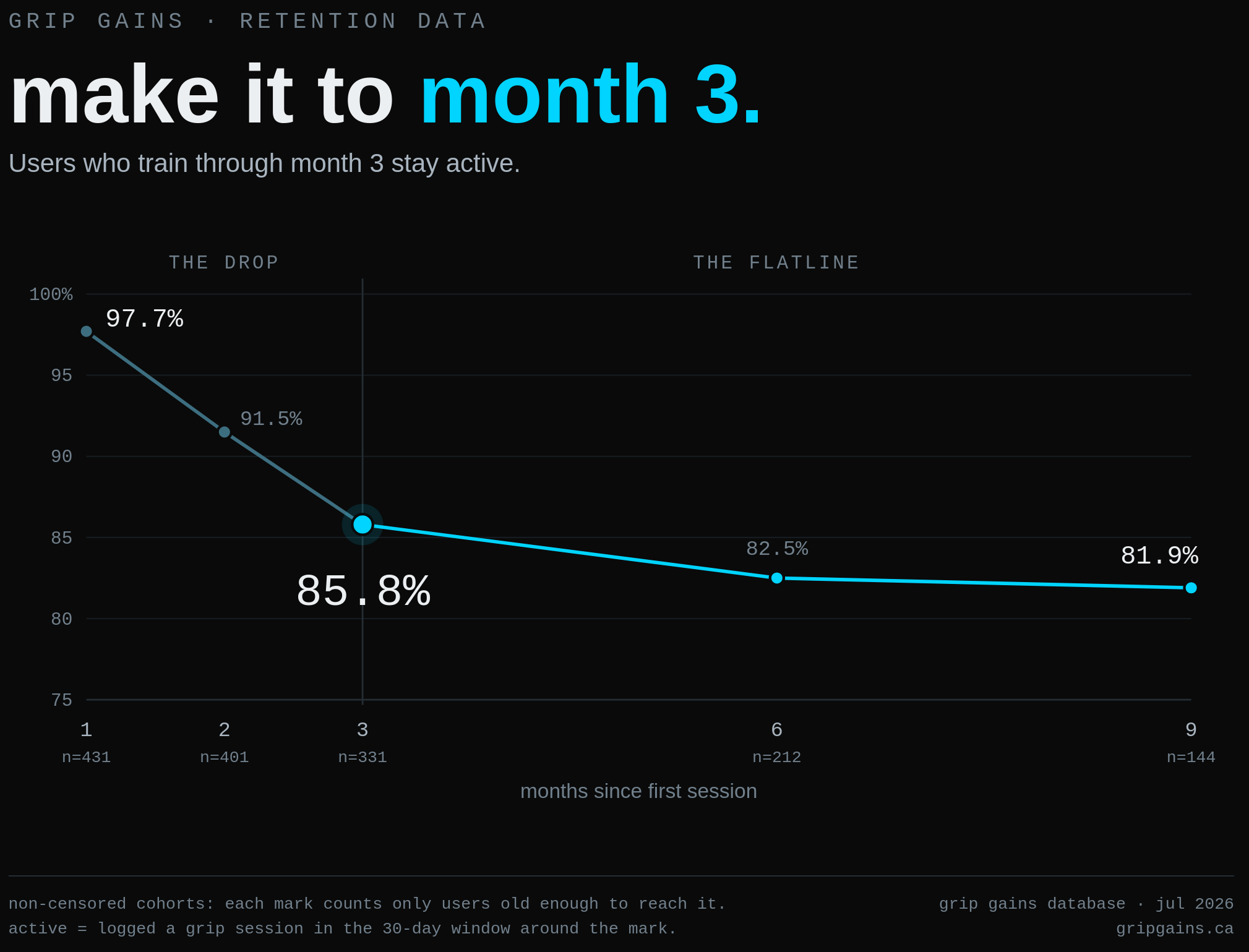
Month 1 retention: 97.7%. The psych is high. Almost all attrition happens in a two-month window — not spread across the year, concentrated right there. Months 2 to 3. Navy SEAL training has a 70% attrition rate with the majority concentrated in the first phase, known as "hell week". Grip Gains is exactly the same.
This is not an "everyone succeeds" story. It's a "here is exactly where hell week is" story.
The system can tell you what to do. It cannot show up. That part is yours. Make it through the first three months and you'll be rewarded with what comes next.
Grip Gains works. I knew this all along. Now I can prove it.
What Survival Looks Like
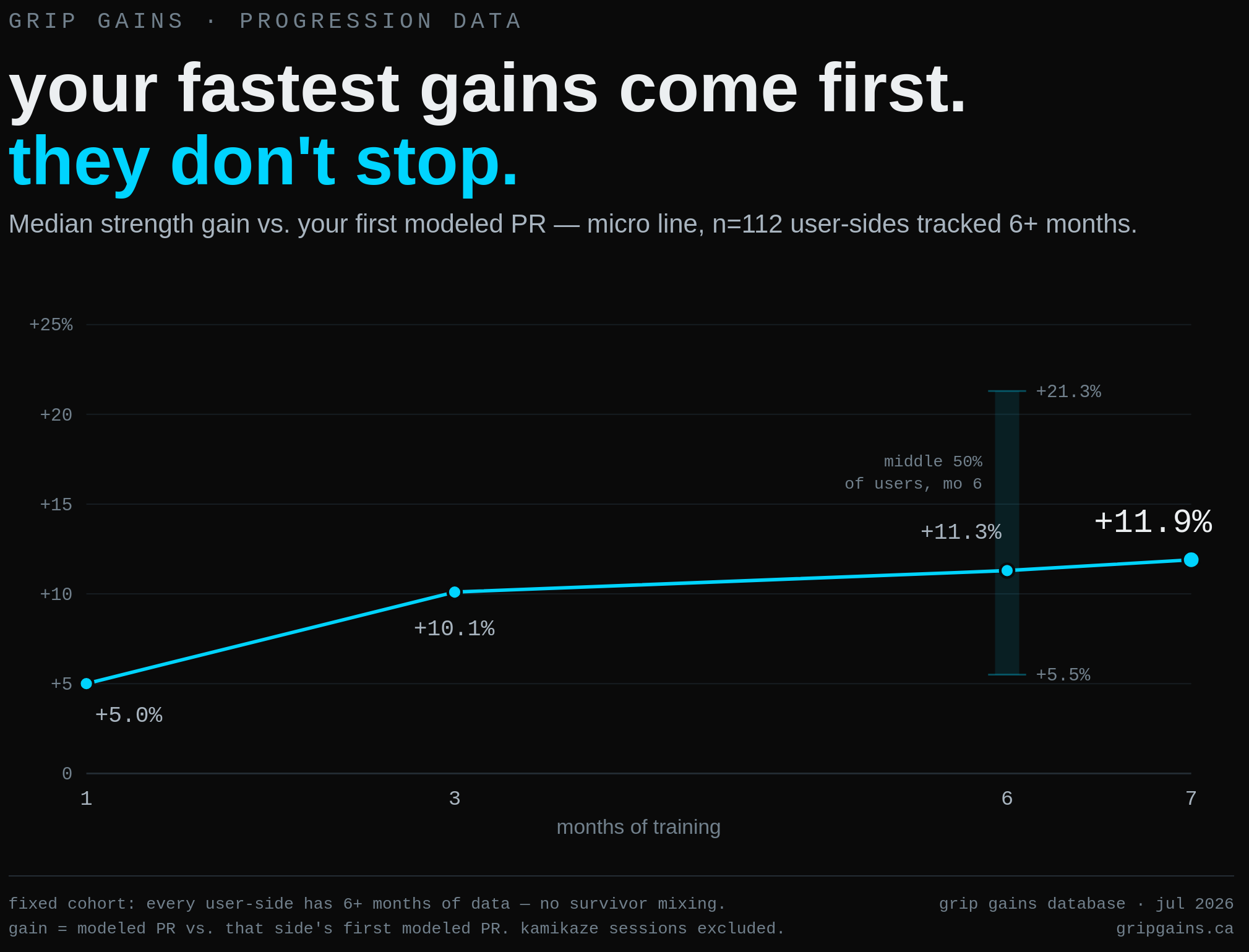
We used CMF for this analysis — and CMF is the hardest metric we track to move. The x-intercept of the force curve, derived from the complete force-duration profile, resistant to noise, impossible to game with explosive junk. Not a peak force number. The floor. And it still moved like this.
Roughly 60% of first-half-year gains land in months one through three. The rocket ship. Neurological adaptation comes fast — contractile tissue comes slower but keeps coming. The curve decelerates. It does not plateau.
An important caveat: the modelled CMF baseline requires 30 sessions to fit a force curve. Beginner gains are already baked into the starting point. Every number above understates true progress from day one.
Now read the spread. The range runs from 5.5% at the low end to 21.3% at the high end — with a meaningful tail above that. This is a fully intention-to-treat analysis — every user pooled, regardless of adherence or execution quality. The climber who logged 15 half-hearted sessions is in there pulling the average down. The median is being dragged down by the ones who didn't show up. The high end is what commitment looks like. Lets look at that next:
CMF is the floor. Here's the ceiling.
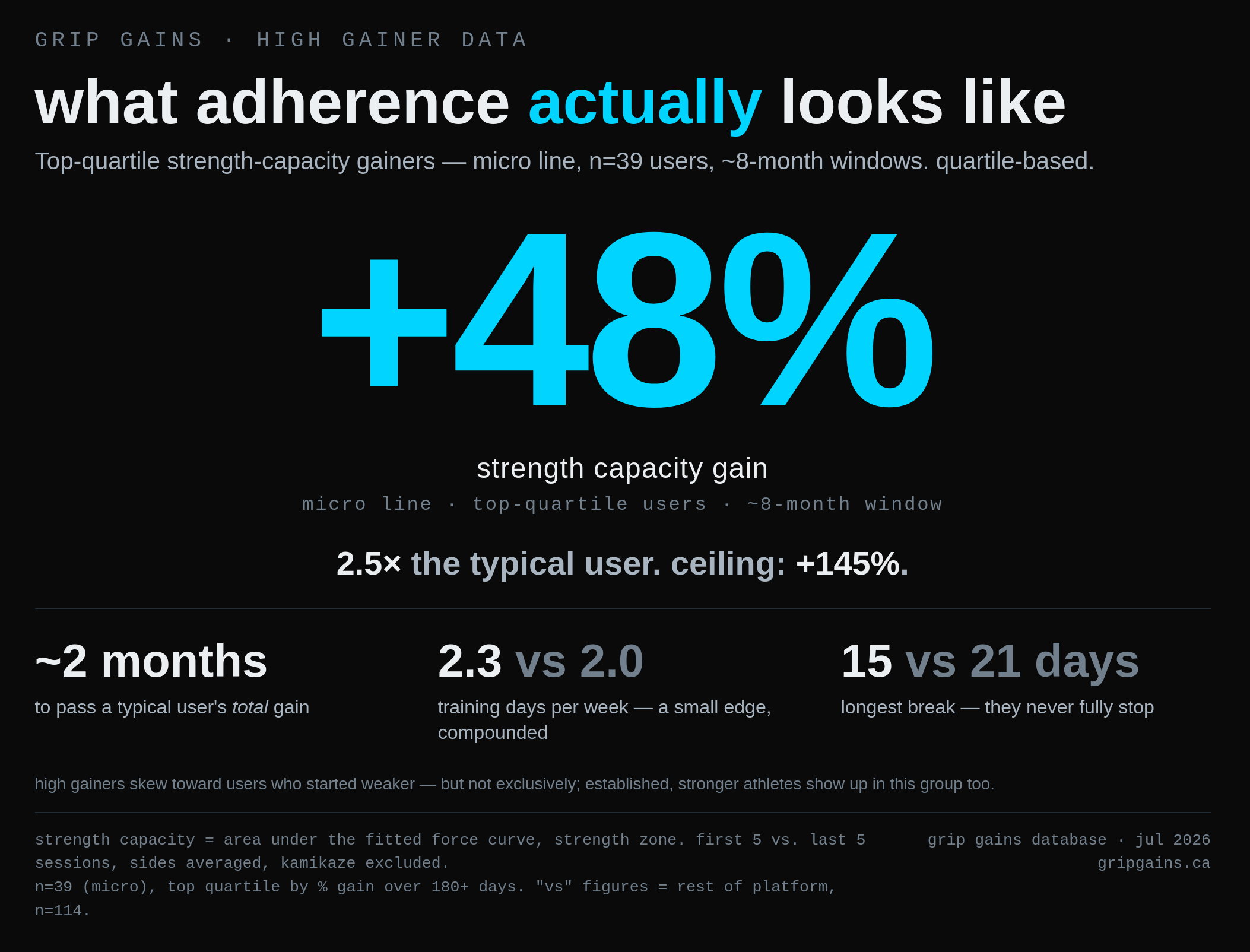
Strength and endurance zone capacity — the actual zones where climbing happens — gained significantly more than CMF. The high gainer cohort on Micro strength: +48% . Not a typo. Not a filtered sample. +48% IN 8 MONTHS ON AREA UNDER THE CURVE 🤯
The +48% is what commitment to the program looks like on the most important metric in rock climbing.
Here's the part worth sitting with: we didn't have to set a hard bar to find this group. No 3-day-a-week requirement, no minimum session count, nothing but time. Stick around 8 months — that's it, that's the only filter — and you've got roughly a 1-in-4 shot at landing in this tier. Not because we drew the line generously. Because simply staying is most of the battle. The users who quietly kept training, at whatever pace they could sustain, without a long gap — a real chunk of them ended up here.
This matters because month 3 to month 6 is exactly when users start convincing themselves they've plateaued. The data says otherwise. Smaller gains per month is not zero gains per month. Don't confuse the rocket ship levelling into a steady climb with a plateau.
Who Gains Most (and Why It's Probably You)
The army has athletes at every stage of their journey — novices, people coming off long injury cycles, V14 climbers, and world-record grip athletes. Everyone is gaining. As expected, there is wide variation around these gains. I'd sell redundant organs for the lowest 5% gains on that chart at my stage.
Obvious next question: who's actually getting stronger, and by how much? We pulled CMF across every user with enough history to trust the number. Here's what showed up.
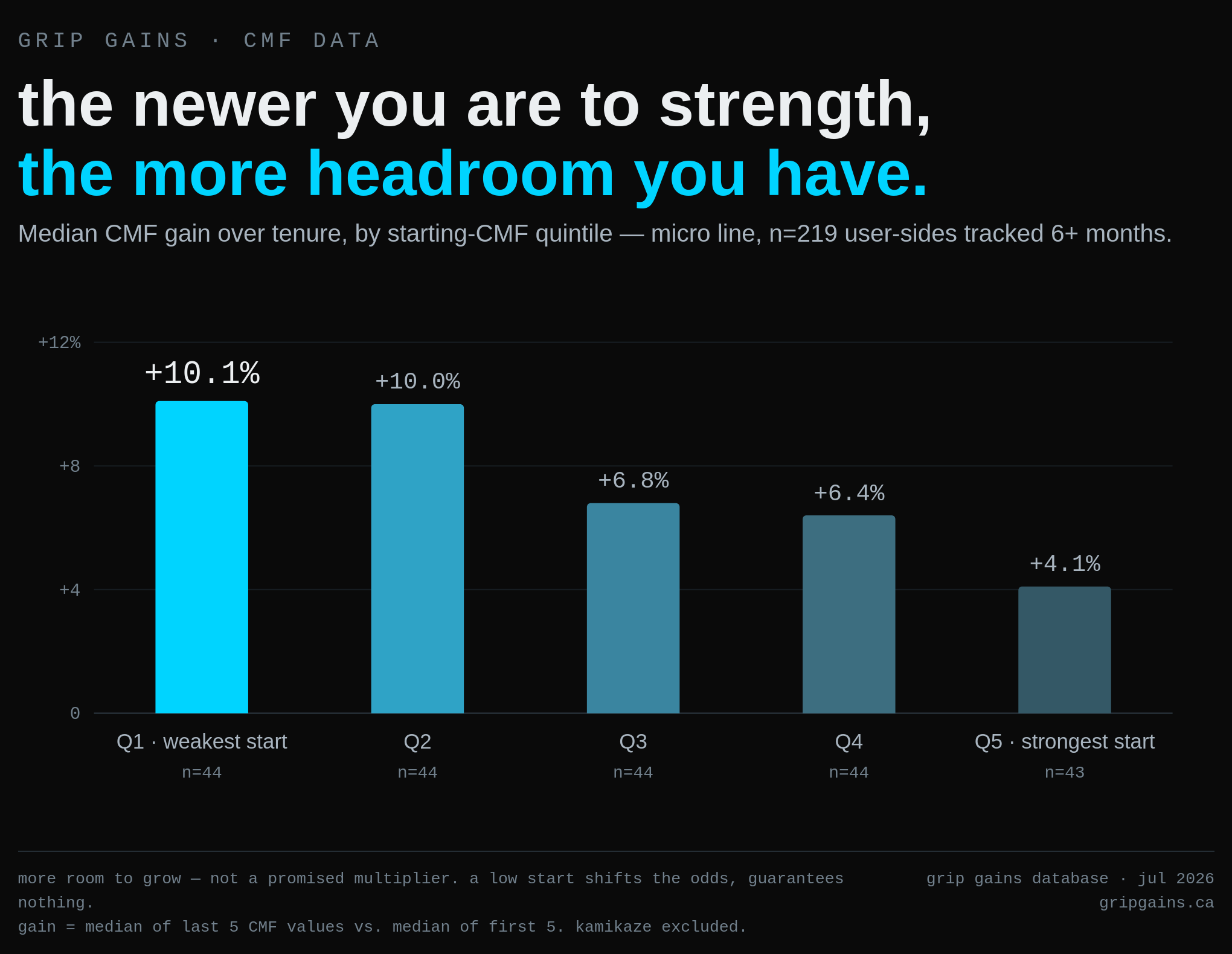
Start weak, gain more — percentage-wise. Start strong, gain less. This is not a surprise to anyone who's touched a barbell before, but now it's on our data instead of someone else's. The weakest quintile gained roughly double to triple what the strongest quintile did, in percentage terms.
Human performance is asymptotic in all sports. The strongest quintile isn't gaining less because something's wrong — they're gaining less because there's less percentage left to gain. Applied physiology at work.
If you're new and the early numbers look big — that's real, and that's supposed to happen. If you've been at this a while and your percentage gains look smaller than a newer athlete's — also real, also supposed to happen. You're not doing it wrong. You're further up the same hill.
Grades in climbing reflect this same phenomenon. The secret the pros aren't talking about: V17 is barely harder than V13. V20 will be a LARP — V15 plus some morpho nonsense. There is an upper bound; the climbing world just doesn't do math and physiology very well.
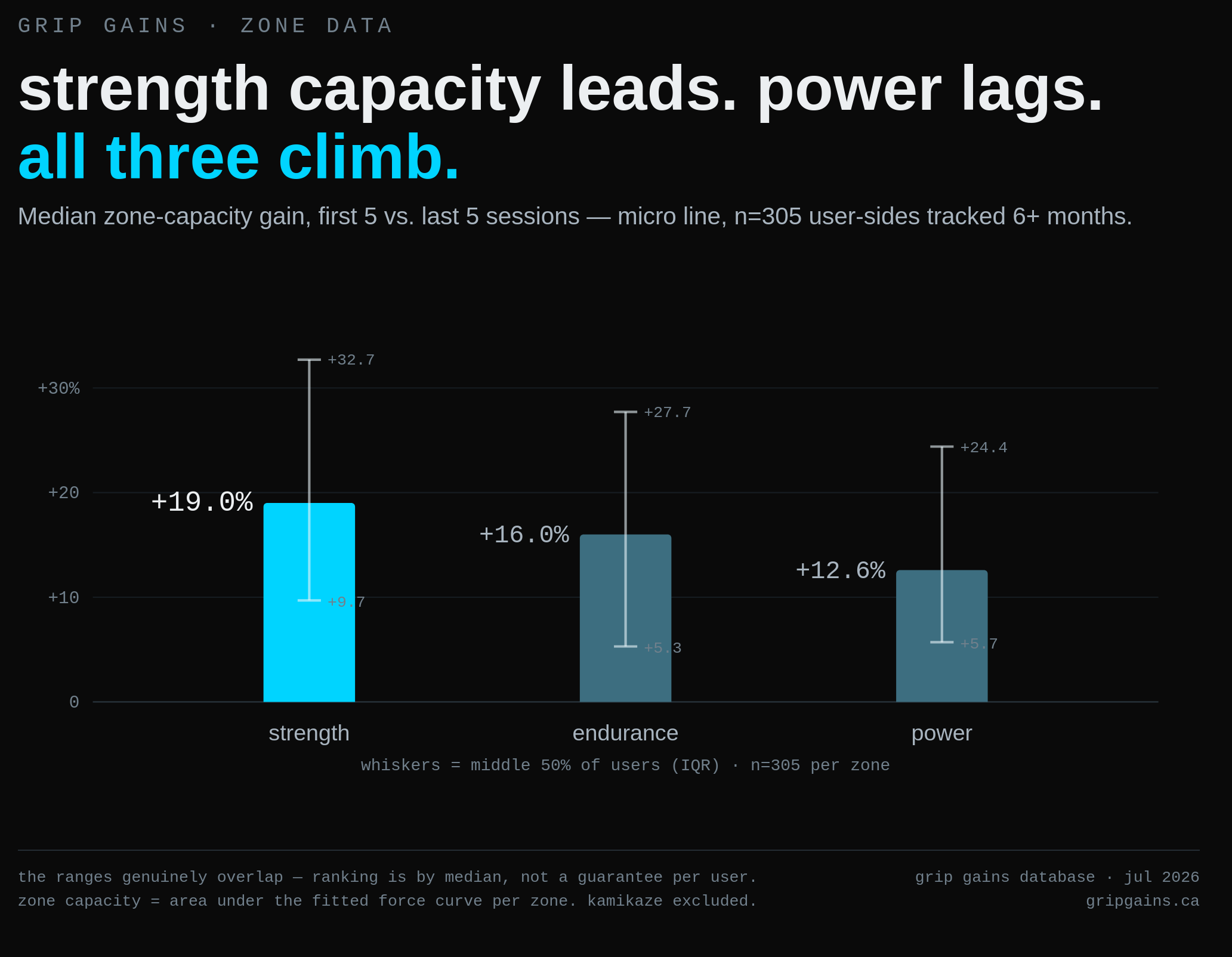
Break the force curve into its three zones and strength capacity comes out ahead — endurance close behind, power trailing. All three go up. Nothing goes backward. The gap between zones is smaller than it looks at a glance once you account for the spread — plenty of athletes buck the pattern entirely.
The take away? Strenght is the zone where climbing occurs and is the engine of your gains. Train complete.
One more thing worth saying plainly, because it won't get its own chart: we checked whether the athletes gaining the most had smoother, more stable performance trend lines than everyone else. They don't. High improvers and low improvers show the exact same volatility — the same session-to-session swings, the same dips in month two and three, the same jagged line.
Coach GG keeps repeating: "You make gains on the grind. You see them on the rocket ship." Analysis of 77000 training sessions supports this.
If your Performance Trend chart looks like a seismograph, that's normal. It looks that way for the athletes gaining the most too.
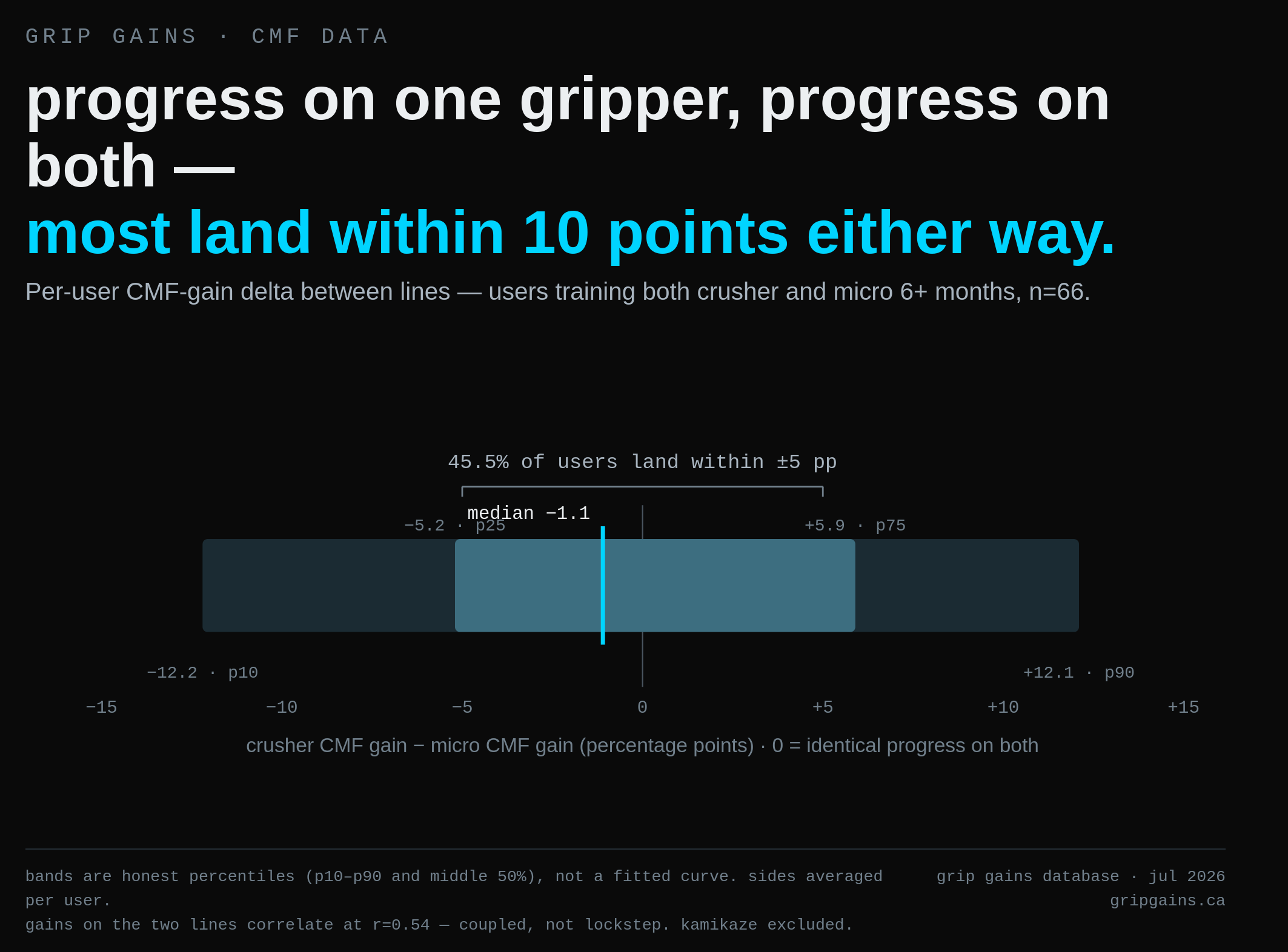
Last check: does progress on one gripper mean anything for the other? For most of you, yes — improvement on crusher and improvement on micro move together more than they don't. The gap between your two numbers is usually small, and it's not systematically wider on one gripper than the other. If your crusher and micro numbers don't match perfectly, that's the normal case, not the exception.
PRs Never Stop
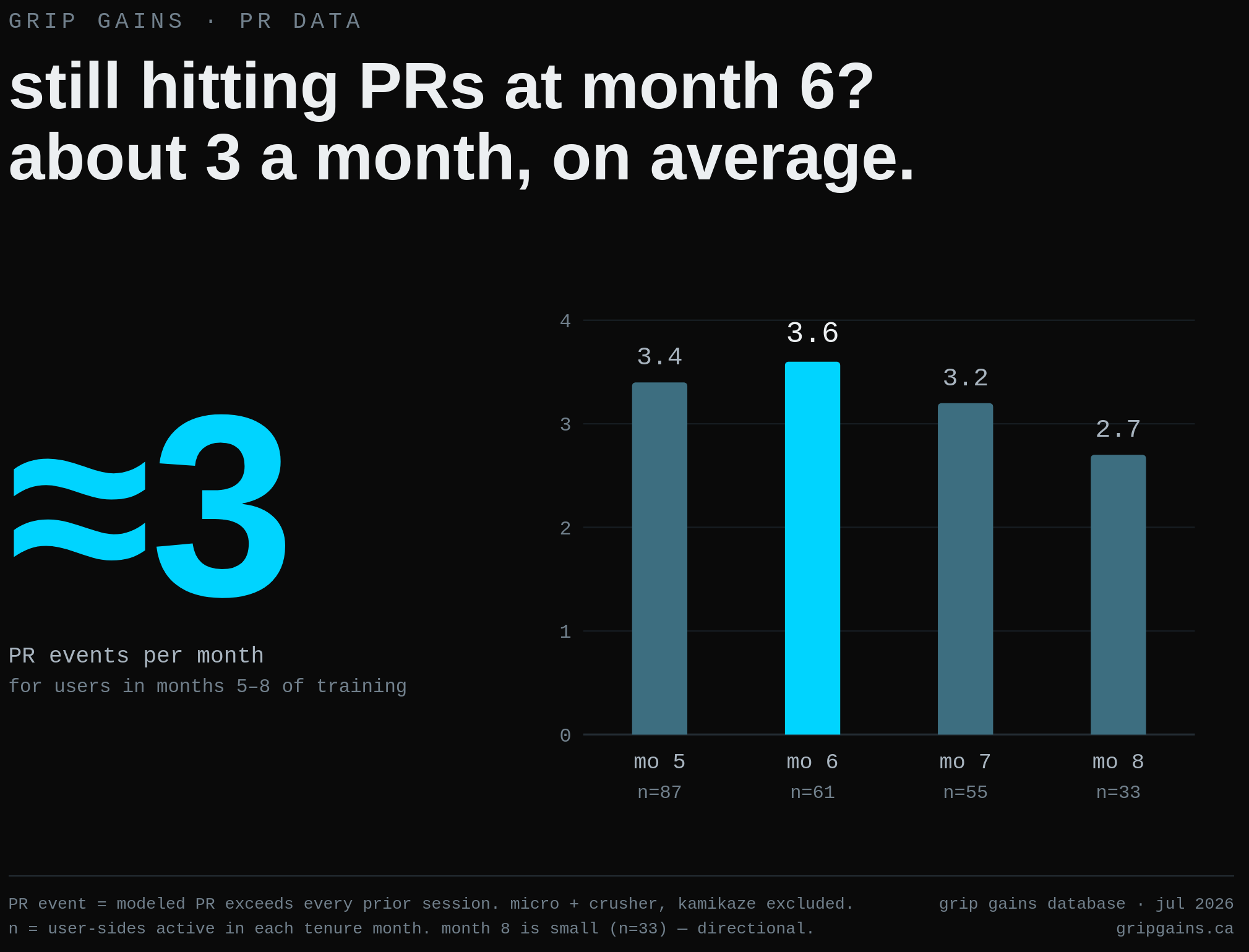
We've excluded the first month from analysis — the model is still settling, so early PR events overcount a little. Months five through eight don't have that problem. The model is well-fit by then. Those CMF PRs are real.
Three per month is not "beginner gains." Three per month at month six is the system working exactly the way it's supposed to — slow enough to be sustainable, consistent enough to be meaningful, visible enough to tell you to keep going. The force curve compounds. So does the motivation — if you survive the 3 month cull.
Optimum Training Volume
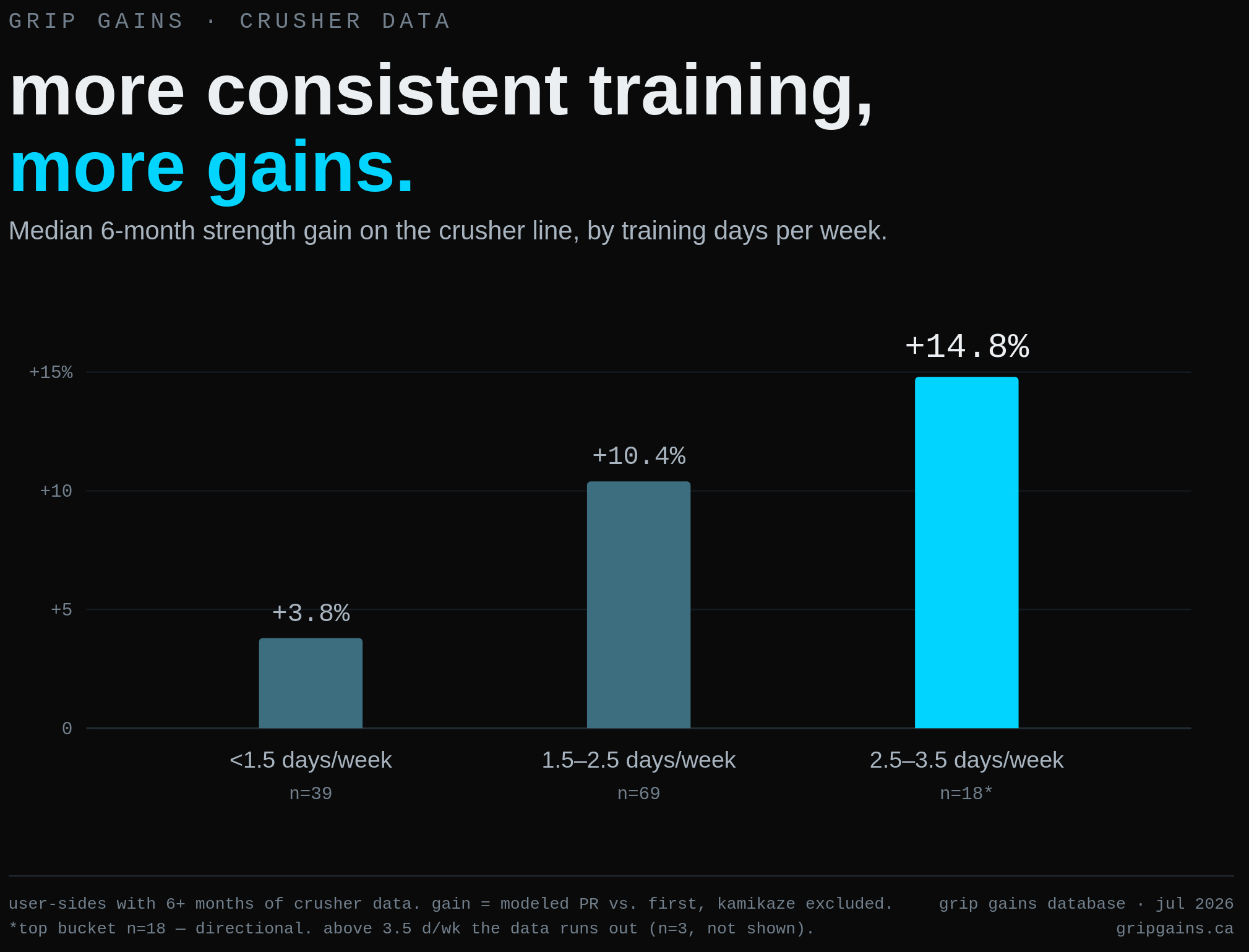
That gradient is monotonic and clean — the clearest dose-response signal in the entire dataset. Users training 2.5 to 3.5 days a week gain nearly four times what the sub-1.5 group does. We checked whether this was really just experience wearing a frequency costume — it isn't. Hold calendar time constant and the gradient survives, sessions or no sessions. Crusher genuinely rewards showing up more often.
Every frequency cohort we can actually measure — up to about 2.5 to 3 days a week — points the same direction. Past that we're down to a handful of users. We don't know what happens at 4 days a week yet. Don't extrapolate a training plan out of three data points.
Here's the twist, though. We ran the same check on micro expecting the same shape. We didn't get it. 😲
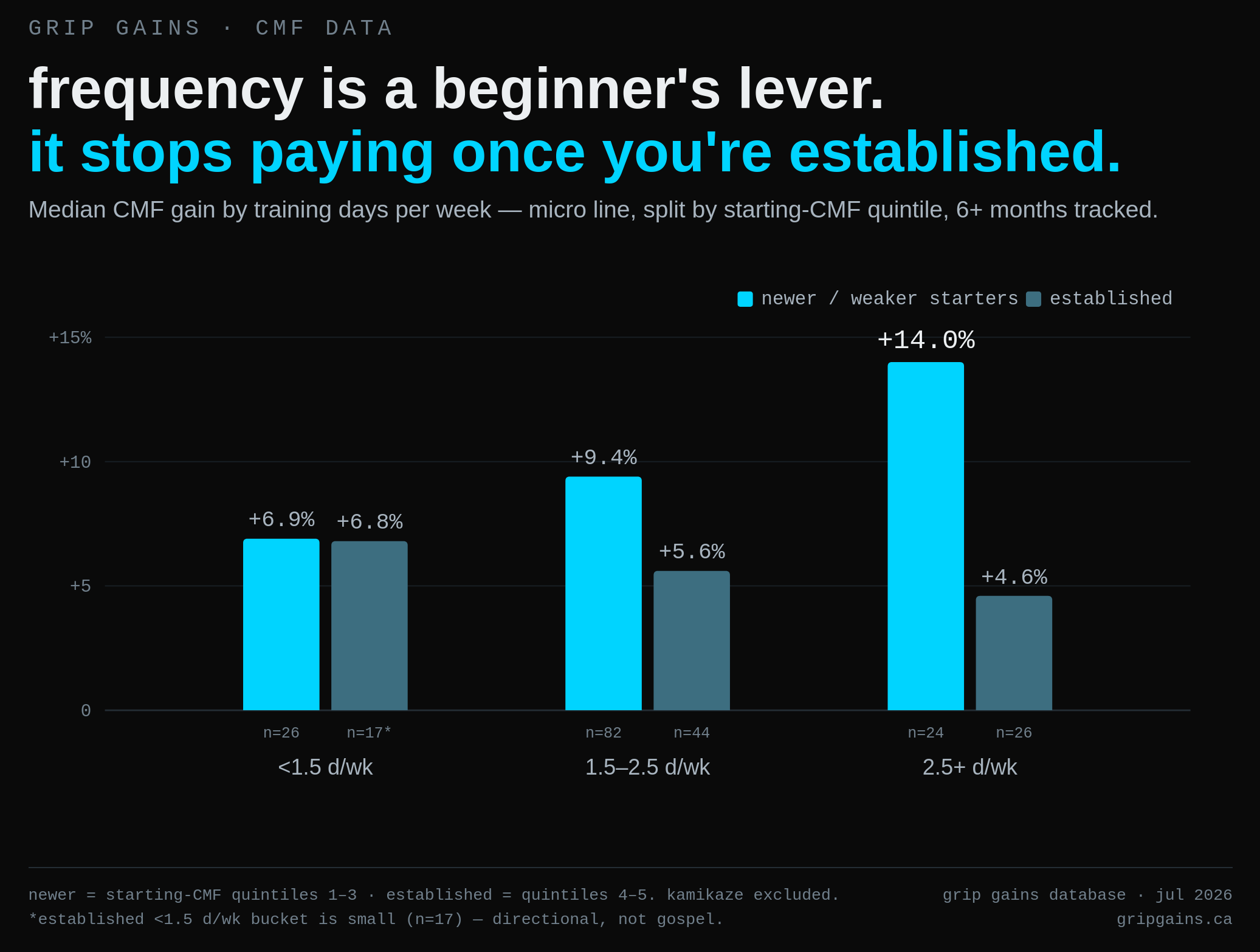
Frequency isn't a permanent rule. It's a beginner's rule. Split micro users by how established they are on the line, and the gradient reappears exactly where you'd expect — among people newer to it. Weaker/newer starters go from roughly 7% gains at low frequency to 14% at high frequency, same shape as crusher. Established users show nothing. Flat at best.
The actual advice: new to a gripper, any gripper? Push frequency toward 2.5 to 3 days a week — the data says it pays off. Established and plateaued? More days a week is not your fix. Something else is. What that something else is, we aren't ready to disclose — that's next year's blog post. 😈
Now the negative result, which matters just as much:
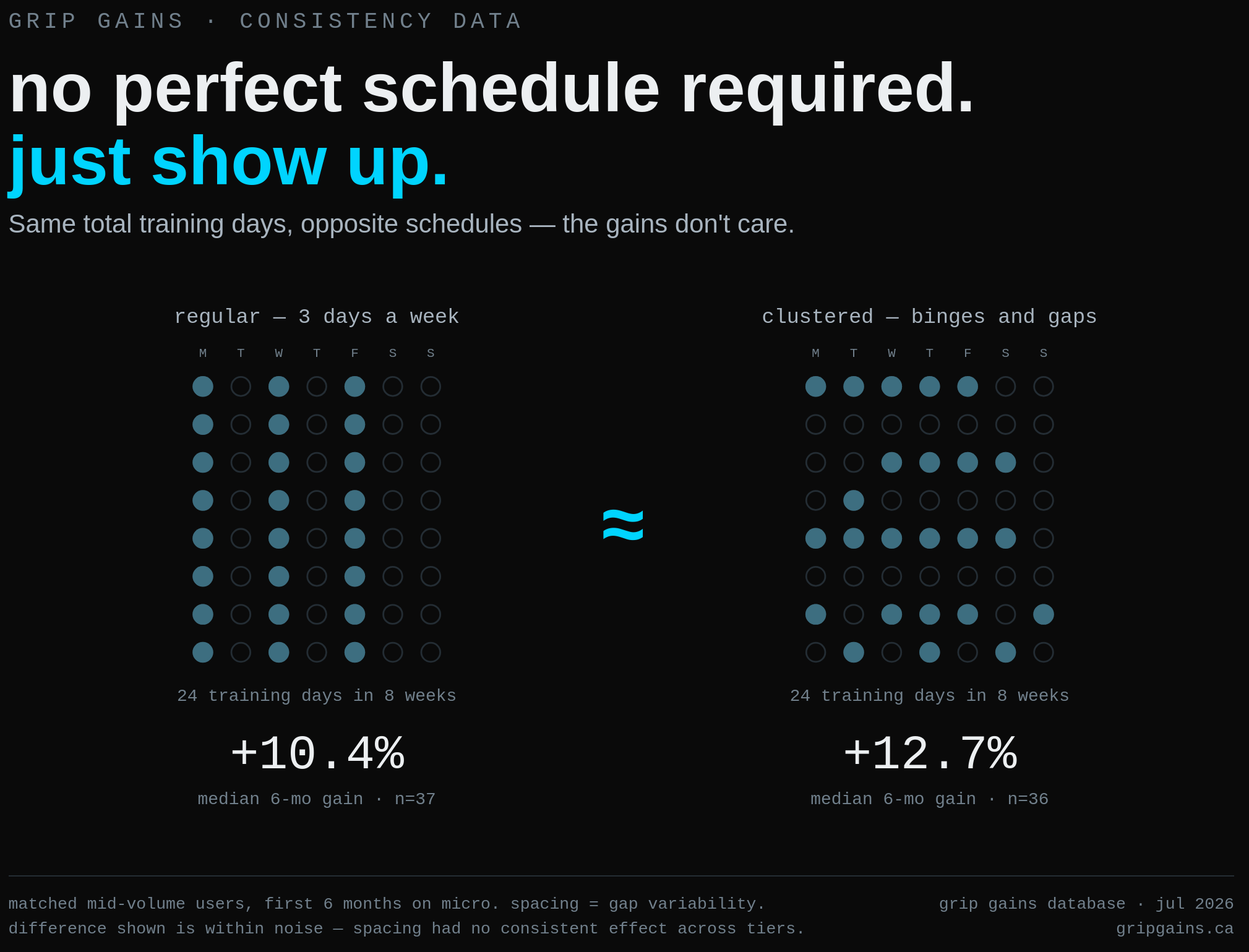
Users were split by schedule regularity — consistent spacing versus clustering sessions into bursts — within matched total-volume groups. No coherent effect. Regular schedules didn't outperform clustered ones. Clustered didn't outperform regular. Total training days was the variable that mattered. The calendar shape was noise.
This platform is built specifically to not care about your schedule. There's no penalty for missing Tuesday. There's no reward multiplier for a seven-day run.
We recommend and track annual volume only. How you get there is up to you. The data supports this approach.
Show up the total number of times. When you do it is your problem to solve, not the app's.
The practical summary: if you're new to a gripper, 2.5 to 3 training days a week is where gains separate from the field. Over six months that's roughly 65 to 90 sessions. You don't need a rigid schedule to get there — total sessions are what count, not how evenly they're spaced. Once you're established on a gripper, frequency stops being the lever — but that's a problem for a future post, not this one.
Grip Gains philosophy confirmed.
The findings reduce to the same thing the platform philosophy has said since day one: show up enough times, try hard enough each time, reapeat for years. That's the entire program.
The data are clear: users dipping a toe in grip gains (hedging with traditional training) are doing dramatically worse. Whatever those users are doing as their side hustle (probably repeaters 😂) isn't working - we have their force curves to prove it. Users who commit are outperforming them by 400%.
Plan trusters are absolutely crushing the filthy casuals - 400% more gains 😲
Make it to month 3. You have a 98% chance of making it to month 8...
Make it to month 8 - you have a 1 in 4 chance of a consolidated 50% gain in your climbing performance.
Principle 9: Know the way. The educational resources are half the program — and right now, you are looking at receipts. Real sessions, real users, real gains across the actual distribution. Use the resources provided to collapse the probability function of being a high gainer into a known outcome.
We've made this post public so you can share it — with your motivated friends.
Survive the wall. Trust the process. Evolve.
❤️ Coach Grip Gains