Today we're pulling back the curtain on something we've been quietly building for a decade.
Gravity Gains — our calorie management system for serious athletes — is finally seeing the
light of day. Strap in, eggs. We're going somewhere uncomfortable.
Let's get one thing out of the way immediately. This is not a diet app. I have approximately
zero interest in helping you lose weight for your high school reunion. This is a performance
tool for athletes who understand that body composition is just another variable in the climbing
performance equation — and who are tired of having that variable managed by vibes, intuition,
and a collection of deeply held personal myths.
Speaking of myths: you underreport your calories by 20–30%. Not you specifically, obviously. The other guy. But also you. This isn't a moral failing — it's a universal human cognitive bias so consistent you can set your watch by it. We know this because we can measure it. More on that shortly.
The Core Philosophy: Your Scale Doesn't Lie (But Your Brain Does)
Rock climbing is a strength-to-weight sport. This is the kind of sentence that makes people defensive, and that defensiveness is itself useful data about how emotionally loaded this topic is. So let me be precise about what we're actually saying.Your force curve is the whole story of climbing performance once technique, training, and recovery are optimized. Body weight raises or lowers the entire curve uniformly. Going up a grade doesn't require you to be lighter. It requires you to have a higher force curve. But if your force curve is maxed out for your current training age, moving it up 5% by addressing body composition is faster than another year of grinding on the grippers. That's just math.
We are not here to make you feel bad about your body. We are here to help you send harder things. If those goals are in conflict for you personally, this tool is not for you, and that's completely fine.
For everyone else: the objective source of truth is your weight. Not your calorie app. Not your fitness tracker. Not your gut feeling about how clean you've been eating this week. The scale. Every morning. That's the signal. Everything else is noise we filter mathematically.
What You Get Right Now: The Foundation
Every Grip Gains user gets immediate access to the first half of the system — daily weight tracking powered by a two-compartment energy dynamics model.Here's the problem this solves. Your weight does not move in a straight line. It oscillates daily based on two completely different biological processes operating on totally different timescales:
- Fast compartment (glycogen + water): Responds in 1–3 days. Driven by carbs, sodium, and training load. Capacity around 5 lbs. High noise, low signal.
- Slow compartment (fat + lean tissue): Responds over weeks. Unlimited capacity (ask me how I know...). This is your actual body composition changing.
We track these compartments separately using dual exponential moving averages. When the fast trend diverges from the slow trend, we know you're refeeding after a deficit, or depleting glycogen after a hard training block. We can convert weight changes to calorie equivalents at any timeframe. No food tracking required for this layer.
The result is a long-term performance trend that becomes another powerful training indicator alongside your grip metrics. The observable trends are remarkable:
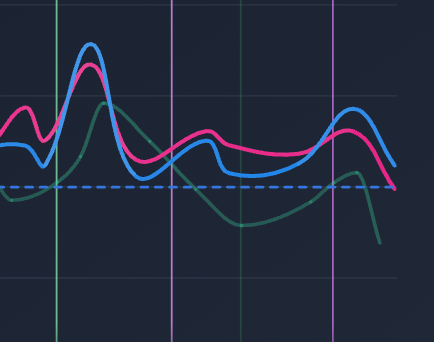
Your body composition, finally speaking a language your training program can understand.
What's Coming: The Full System
The complete Gravity Gains program closes the loop with activity and calorie tracking. This is where the paradigm shift becomes genuinely revolutionary.The system compares two numbers: what actually happened to your body (from the weight data), versus what your logs say should have happened (from your tracked intake and activity). The difference between these two numbers is your correction factor — applied automatically, updated continuously, requiring zero effort from you beyond showing up and logging. Good or bad, it doesn't matter.
What does this correction factor absorb?
- Your systematic calorie underreporting (yes, yours)
- Metabolic adaptation as your body responds to training
- NEAT changes — those unconscious movement and fidgeting differences that are impossible to track directly
- Salt, water, fiber, project-related laxative abuse — whatever you get up to
The correction doesn't care why there's a gap between predicted and observed. It measures it and accounts for it. This is essentially a Kalman filter — the same mathematics that guides GPS systems and spacecraft — applied to your metabolism. It is not magic. It is math.
The Innovations That Actually Matter
Calorie-first design. Like your grip training metrics, you get sophisticated analytics simplified to pure action. Nothing lives in this app that isn't directly actionable. If it doesn't change what you do today, it doesn't exist. All ice cream diets are fully supported by Gravity Gains — no kink shaming here.No psychology of failure. There are no fixed diet plans here. There is no falling off the wagon. At any moment, you are either moving toward optimal energy balance or away from it — with no moral weight attached to either direction. The system always knows where you are and always knows how to get back on track. This is intentional and it is non-negotiable.
Minimum viable logging. If tracking takes more than 60 seconds total for the entire day, it is too much friction and will not survive contact with a real life. Commercial apps are genuinely catastrophic in this regard. Our primary input method is calorie density — dramatically faster and more accurate than database lookups.
The UI fits on one screen. No sub-menus. No tabs. No rabbit holes. Ten years of iteration taught me that every additional tap is an abandonment event waiting to happen. The entire interface fits on a single screen. That's a design constraint we treated as sacred.
Activity logging based on human psychology. Not lookup tables. Not metabolic equivalents for "moderate recreational dancing." Real inputs that real athletes can log accurately in real time without consulting a spreadsheet. If you spend more than five seconds thinking about this, you're likely rationalizing failure. Your spiritual weakness is irrelevant to Gravity Gains — the algorithm sorts it out anyway.
Weight as the objective source of truth. Every correction, every target adjustment, every feedback loop runs through the scale. Because the scale doesn't have an agenda. It doesn't remember what you told it yesterday. It just tells you what happened.
The Leaderboard Gets Smarter
Here's something the grip training leaderboard has always gotten wrong, and that we're finally in a position to fix.Strength-to-weight ratio is the relevant metric in climbing. A 160 lb athlete closing a gripper at 120 lbs is not performing equivalently to a 130 lb athlete doing the same. The raw number looks identical. The athletic achievement is not. Anyone who has spent time around elite climbing understands this intuitively — we've just never had the infrastructure to account for it systematically.
Users who track in the Gravity Gains system will unlock weight-normalized leaderboards. Your performance expressed relative to your body weight. The metric that actually predicts who sends the project.
This is not a participation trophy system. It is the opposite. It is a more honest competition — one where gaming the rankings by carrying extra mass stops working, and where the athlete with optimal body composition for their strength level gets appropriately recognized. It also means the 130 lb climber with elite relative strength isn't buried under a pile of chubby beginners who can move more absolute weight off a pulley.
The weight data has to come from somewhere reliable. That somewhere is daily weigh-ins in Gravity Gains. No tracking, no normalized ranking. This is not bureaucracy — it is the minimum data quality standard required to make the number mean anything. If your reported weight is from three months ago and a different phase of training, the normalization is noise. We are not interested in producing impressive-looking noise.
Who This Is For
This is being made available to our most dedicated users on an as-is basis. We are not your emotional support platform. (https://www.betterhelp.com/)I am not interested in building an education program around calorie tracking. People are too emotionally invested in this topic, and that investment makes them resistant to exactly the kind of honest feedback this system provides. If you need to be convinced that the scale is more accurate than your feelings, this is not the right tool for you, and no amount of blog posts will change that.
If you are a serious athlete who wants a sustainable, long-term system built on rigorous mathematics instead of motivational language and meal plans — welcome. This is what ten years of refinement looks like. It is not normie consumer software. It is not designed for people who need hand-holding. It's Grip Gains for body composition — it works.
More details on rollout coming shortly. In the meantime: start your daily weigh-ins. The algorithm wants to meet you.
❤️ Coach Grip Gains